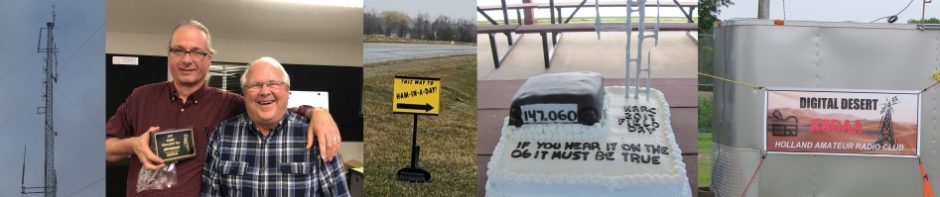
The Holland Amateur Radio Club maintains 3 repeaters under the K8DAA club callsign:
- The “Oh Six” – 147.06 (+) PL: 94.8Hz
- The “Warm Friend” – 146.500 MHz and receives on 147.500 MHz. PL: 94.8Hz
- The “Four Forty” – 443.825 (+) PL: 94.8Hz
Let us introduce you to each machine:
“06”
Our main repeater. It transmits on 147.06 MHz. Your radio needs to be in the positive offset so it transmits on 147.66, and you will need the 94.8 “tone”.
This is the oldest of the three club repeaters. It began life sometime around 1973 and was on 146.88 with tube-type equipment that came from the Ottawa Co. Sheriff’s Dept. It was originally located at the QTH of W8IQF on Lugers Rd. on the west side of Holland. It was soon re-located to the tower of WZND on Main St. downtown Zeeland, which was owned by Chuck W8GCW.
Around 1975, the club purchased a VHF Engineering solid-state repeater, which greatly improved reliability and performance at the time. It was still just a simple repeater with no enhancements, so Harry WB8SHM homebrewed an autopatch for the repeater. The patch served for a number of years until we upgraded to an ACC RC850 repeater controller in 1985 that controlled all functions of the repeater except for voting of the receivers.
The autopatch was discontinued in December of 2009.
Around 1977, the repeater was moved to the tower owned by Rooks Transfer on Waverly Rd, which resulted in greatly improved coverage. When Rooks went out of business in 1981, we moved the repeater to the Holland Hospital, where it is located still today.
In 1983, the VHF Engineering receiver was replaced with a Motorola Motrac, with a good improvement in receive coverage. In 1984 the VHF Engineering transmitter was replaced with a GE Mastr.
We have two remote receivers on the system. The South Receiver is located 110 feet above ground level on a tower owned by Tele-Rad two miles north of Hamilton on 47th St. at 139th Ave, and the North Receiver is located 180 feet above ground on the Hamilton Farm Bureau feed mill located at US 31 and Van Buren north of Holland. The remote receivers are linked back to the hospital on separate UHF frequencies. There, all three receivers are connected to a Hall Electronics voter that determines the best signal/noise ratio, and the audio of the winning receiver is routed to the repeater controller for further processing as needed. The ‘voting’ takes place continuously, so the ‘voted’ receiver can (and does) change many times per second in response to mobile station travels. This voting, unnoticed during a contact, improves the repeater’s response to multipath and other changes of received signals and greatly improves the quality of the contact.
The 2M antennas at the hospital and north and south receiver are a Decibel Products DB224 vertically stacked array of four exposed dipoles. This antenna yields about 6 dbd of omni-directional gain. The main antenna on the hospital antenna is connected for simultaneous receive and transmit duty through a duplexer.
The repeater RF equipment is a mixture of brands. The two 2M remote receivers and UHF link transmitters are GE Exec II, the link receivers are Motorola Micor and the 2M receiver at the hospital is still the old Motorola Motrac. The 2M transmitter at the hospital is a GE Mastr II, installed in April 2001.
The repeater requires a 94.8Hz tone for access and also transmits 94.8Hz to allow for tone decode in your receiver. Receiver decode makes monitoring the machine much more pleasant, especially when the band is ‘open’ and signals from repeaters across Lake Michigan are strong. (Users without tone encode capability can key 061, which will cause the repeater to go to carrier access. It will in remain carrier access mode until the repeater is idle for 30 seconds, or until 060 is entered.)
The repeater has a remote base at the 145.49 Grand Haven repeater. These repeaters can be linked on demand, and Holland and Grand Haven repeaters are usually linked during Skywarn nets to provide wide area coverage of the whole county. The Holland 06 repeater can also be linked to our 70cm repeater.
The Warm Friend
The club has another two meter repeater located in downtown Holland atop the Rest Haven Warm Friend. It is a local machine with no autopatch or other enhancements. The old VHF Engineering repeater is still in service for this repeater.
NOTE: This repeater uses a 1.0 MHz split
This repeater transmits on 146.50 MHz, and you have to transmit on 147.50 MHz, which is a special 1.0 MHz split. You will also needs the 94.8 Hz “tone”.
The frequency pair it operates on was set aside as a low power experimental, local, tone controlled frequency, with no minimum mileage separation between repeaters. Hence the tone requirement on this frequency, to minimize interference between user groups.
The 440
Transmit – 443.825 MHz
Receive – 448.825 MHz.
94.8Hz tone
IRLP Node ID – 4373